Rain
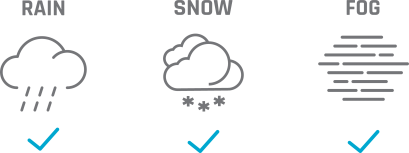
Rain consists of large droplets, and the optical link is not significantly attenuated even in the densest downpours.

KORUZA transmits data as a collimated beam of eye-safe infrared light between two precisely aligned heads. What follows is how that is engineered to stay up, stay fast and stay private.
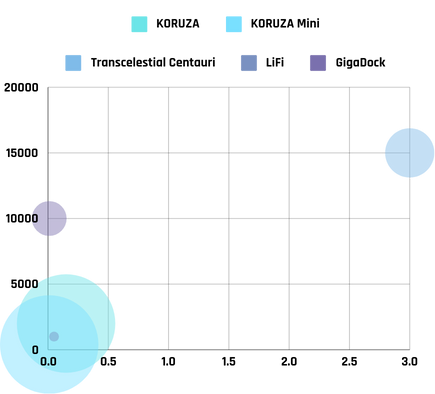
KORUZA is built on open-source software and published hardware. The alignment, control and management code is ours and it is public, so you can read it, change it and keep running your version for as long as you like. There is no vendor lock-in because there is nothing locked.
The data path is a standard SFP transceiver pair. When faster transceivers arrive, the same head takes them: a unit built for 1 Gb/s moves to 10 Gb/s with a module swap, not a new installation. That is the whole upgrade path.
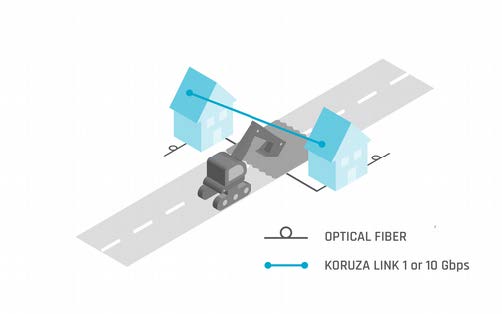
KORUZA Pro is rated for links up to 150 m. That covers most building-to-building links in a city, most industrial sites and, not by accident, the typical spacing of 5G small cells. Over that distance it gives an operator a 10 Gb/s backhaul without a trench, a permit or a fibre lease.
Buildings move. Steel expands in the sun, towers sway, brackets settle. KORUZA Pro watches the received power and re-aims its motorised head to keep the beam on the receiver, so a link aligned in January is still aligned in July. That is what makes it usable on real structures rather than on an optical bench.
Anything that limits visibility also attenuates an optical link. The mechanism is scattering: particles in the air redirect part of the beam, and the closer a particle is in size to the wavelength, the more light it steals. KORUZA carries enough margin to ride through rain, snow and light fog at its rated range. Dense fog is the one condition that can close a link, and we say so below.
Rain consists of large droplets, and the optical link is not significantly attenuated even in the densest downpours.
Snow, like rain, consists of large particles and rarely attenuates the beam much. Mount the unit so snow cannot pile up in front of the window and it will not get in the way.
Fog is the worst case: its droplets are about the size of the wavelength, so they scatter it efficiently. Dense fog can cost 100 dB/km, which is roughly 15 dB over 150 m. We have measured KORUZA through fog on real links; if your site is fog-prone, tell us and we will size the margin for it.
In the right conditions ice coats the front window and blinds the link. An optional heater keeps the lens clear.
A radio signal spreads in every direction. Anyone with an antenna in range can receive it, and anyone with a transmitter can jam it. A KORUZA beam is a few centimetres wide and goes to one place. To intercept it you would have to put something in the beam, and the receiving end would see the power drop.
That removes RF eavesdropping and jamming at the physical layer. It does not replace encryption, and we will not tell you it does. It also works where radio cannot: inside shielded rooms, next to sensitive instruments, and in bands that are congested or off limits by regulation. Defence, aerospace and radio-quiet research sites are where we see it most.
The link budget calculator applies these physics to your distance, wavelength and weather.