
Where KORUZA is used
The same optical link solves a surprising range of problems. These are the six patterns we are asked for most.
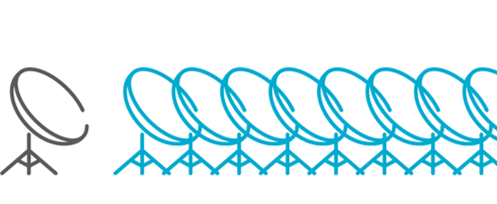
Point-to-point bridging
A pair of KORUZA Pro units bridges two buildings, a road, a river or a railway yard: anywhere a trench is impossible, slow or absurdly expensive.
A rooftop pair replaces a leased line or a fibre run that would need permits, roadworks and months of lead time. Because the spectrum is unlicensed, the only approvals involved are the ones for putting a bracket on a wall.
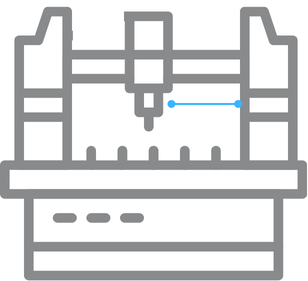
Linear motion applications
Pick-and-place heads, CNC gantries, inspection axes and wafer handlers all have the same problem: a cable that flexes millions of times will break, and it will break on a Friday. KORUZA MINI puts the data on a beam across the moving gap, so there is nothing left to flex.
It eliminates wear from drag chains, enabling reliable, maintenance-free data transfer in dynamic industrial environments. Axes moving at over 10 m/s with accelerations above 30 G are exactly where drag-chain speed and fibre bending cycles become the limiting factor — a cable that flexes a million times is a scheduled failure; an optical gap is not.
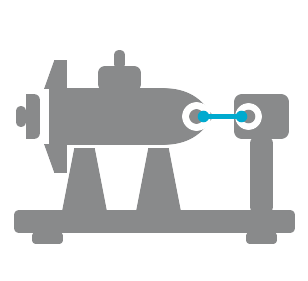
Docking applications
A drone or an underwater vehicle comes back with terabytes of LiDAR or sonar data and a nearly flat battery. KORUZA offloads it across the docking gap at 10 to 100 Gb/s while the vehicle charges, with no connector to line up and nothing to corrode.
There are no connector pins to wear, corrode or misalign, and no contact force to design for. An autonomous vehicle can generate around 1 GB/s of sensor data, leaving 1 to 10 TB to offload within a short docking window — often on battery, where every minute of dwell time counts.
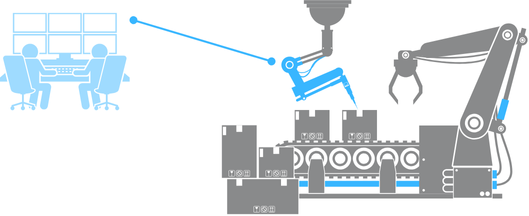
Temporary infrastructure
Field campaigns, radio-telescope sites and air-gapped test setups need a fast link for a season, not a decade. Two heads on tripods give you one in an afternoon, and emit nothing into the radio spectrum while they do it.
Radio-quiet zones are the clearest case: a radio telescope site cannot tolerate an RF link at all, and an optical one emits nothing into the band being observed.
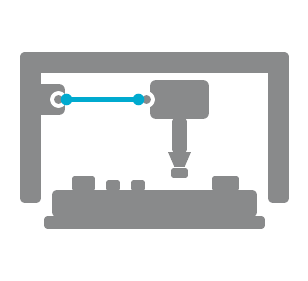
SMT pick-and-place machines
In modern SMT lines the motion is fast, constant and unforgiving. Flex leads break under repeated bending, connectors loosen and drag chains add maintenance. KORUZA replaces the moving cable with a bi-directional optical link of up to 10 Gb/s — a transparent "laser wire" compatible with the existing control protocols but immune to mechanical wear and electrical noise.
No cable fatigue, so the link does not wear out under bending or rotation; no connectors to replace; immunity to electromagnetic interference in electrically noisy environments; and no particles from cable abrasion, which matters in a cleanroom. We demonstrated this live at Productronica 2025 in Munich.
Licence-free networking
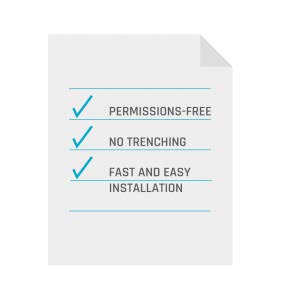
KORUZA transmits data with light, and its eye-safe operation is governed by ordinary health-and-safety regulation. The optical spectrum for wireless communication is not regulated and needs no special permission to install.
No spectrum fees, no licence renewals, no coordination with an incumbent operator, and no interference complaint to answer when someone else lights up a nearby link.
Not sure which one you are?
The product selector maps your application onto a family and speed tier in about a minute.