KORUZA 1.0 scientific website
scientific.koruza.net — features, specifications, history, testing, events and publications.

The low-cost, open-source and open-hardware wireless optical system where KORUZA began.
KORUZA started in 2012 as VALET, a Very Affordable Laser Ethernet Transceiver, developed by Luka Mustafa with Dr. Benn Thomsen at UCL in London. The idea was to reuse mass-produced SFP fibre transceivers and 3D printed optics to bring free space optics to community networks at a fraction of the usual cost.
Five prototype generations followed. KORUZA 1.0, released in 2015 for scientific research, was fully modular, designed in OpenSCAD and published under the CC BY-SA 4.0 licence, with a complete assembly kit and step-by-step instructions so researchers could build, understand and modify it.
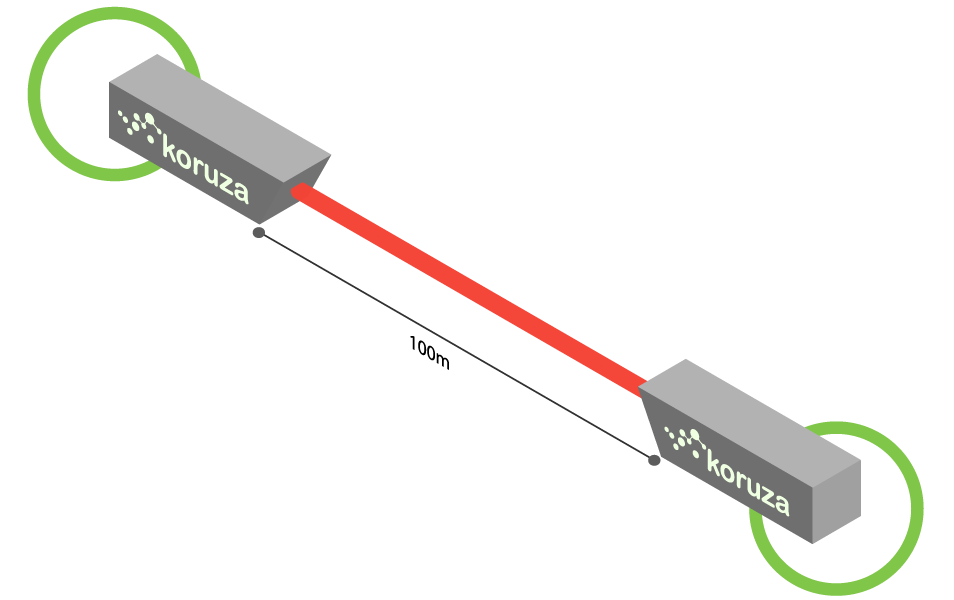
2012 — VALET idea and first prototype, tested at 100 m.
2013 — Paper "Reintroducing Free-space Optical technology to Community Wireless Networks" presented at AMCIS 2013, Chicago; Shuttleworth Foundation Flash Grant; second prize at the IEEE ComSoc Student Competition.
2014 — Institute IRNAS founded; NLnet Foundation grant; generation 3–5 prototypes; World Wide KORUZA experiment with ten links across the globe.
2015 — Shuttleworth Foundation Fellowship; KORUZA 1.0 for scientific research; manufacturing company Fabrikor established.
Complete copies of the KORUZA v1 websites, kept here unchanged so nothing is lost when the koruza.net domain is retired.
scientific.koruza.net — features, specifications, history, testing, events and publications.
instructions.koruza.net — the illustrated step-by-step assembly guide, bill of materials, overview and user manual.
Source files: Mechanical and electronic designs remain on GitHub in the IRNAS/KORUZA repository. github.com/IRNAS/KORUZA